
Navigating Thailand's Demographic Shifts
Strategic Planning for Startups in 2026 and Beyond
Nassim Abed, assisted by Qwen and Sonnet
7/4/20266 min read
Thailand's business environment is at a critical juncture. As we move through the second half of 2026, the demographic trends that have been shaping the country's economic trajectory are no longer future projections — they are present realities. An aging population, shifting labor dynamics, and evolving consumer preferences are redefining the rules of engagement for small enterprises and startups. For those planning to launch or scale in 2026, understanding these shifts is not optional — it is essential.
The Demographic Reality: A Population Already in Transition
Thailand's demographic profile has already crossed a threshold that many businesses still treat as a distant forecast. In 2023, the share of Thais aged 60 and above passed 20% of the population — officially making Thailand an "aged society," a milestone the country reached in less than 20 years after first becoming an "aging society" in 2005 (a pace faster than Singapore, China, the UK, or the US) (NESDC; Krungsri Research, 2025). The trajectory does not level off from here: current projections point to Thailand becoming a "super-aged society" — with 28% or more of the population over 60 — around 2031–2033, and the National Economic and Social Development Council (NESDC) has flagged that the working-age population is now shrinking as a share of the total (NESDC; UNFPA Thailand, 2025).


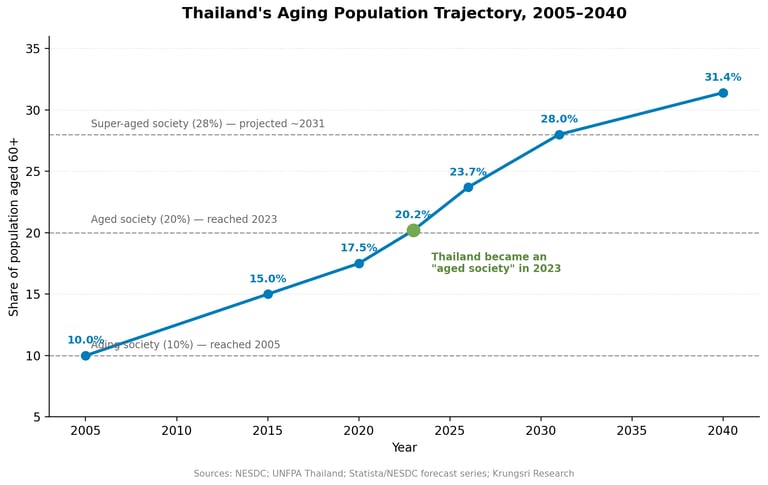
This shift is already visible in Bangkok, where the city functions as two economies at once: a hub for younger, digitally native entrepreneurs, alongside a rapidly graying broader population that is driving new demand in healthcare, financial planning, and home-based services. For businesses, the practical implication is that "aging Thailand" is not a 2030s problem to plan around — it is the operating environment today, and firms that treat it as a future contingency are already behind. At the same time, Bangkok remains the country's dominant startup hub, concentrating the largest share of new ventures, accelerators, and corporate innovation centers, with continued strength in fintech, e-commerce, food tech, and AI-driven solutions (JICA Thailand startup survey, 2025–2026).
Entrepreneurship research also shows a maturing, more credentialed founder base: a recent Global Entrepreneurship Monitor (GEM) study found that 35% of new Thai entrepreneurs now hold graduate degrees, and Thailand ranks sixth out of 45 economies surveyed on entrepreneurs' growth ambitions (GEM Thailand, 2025). This is a market simultaneously aging and professionalizing — a combination that demands business models flexible enough to serve both realities at once.
The Economic Ripple Effect: What It Means for Startups
The digital economy remains one of the clearest bright spots in an otherwise moderating growth picture. The National Board of Digital Economy and Society (BDE) forecasts Thailand's digital GDP will expand by 4.2% in 2026 — roughly twice the pace of the 2.0% overall GDP growth projected by Thailand's Fiscal Policy Office — reaching a value of 5.6 trillion baht and rising from 28.2% of total GDP in 2025 to a projected 29% in 2026 and 30% in 2027 (BDE, 2026; Bangkok Post, 2025). Software, digital content, and smart devices are expected to be the fastest-growing digital sub-sectors next year.
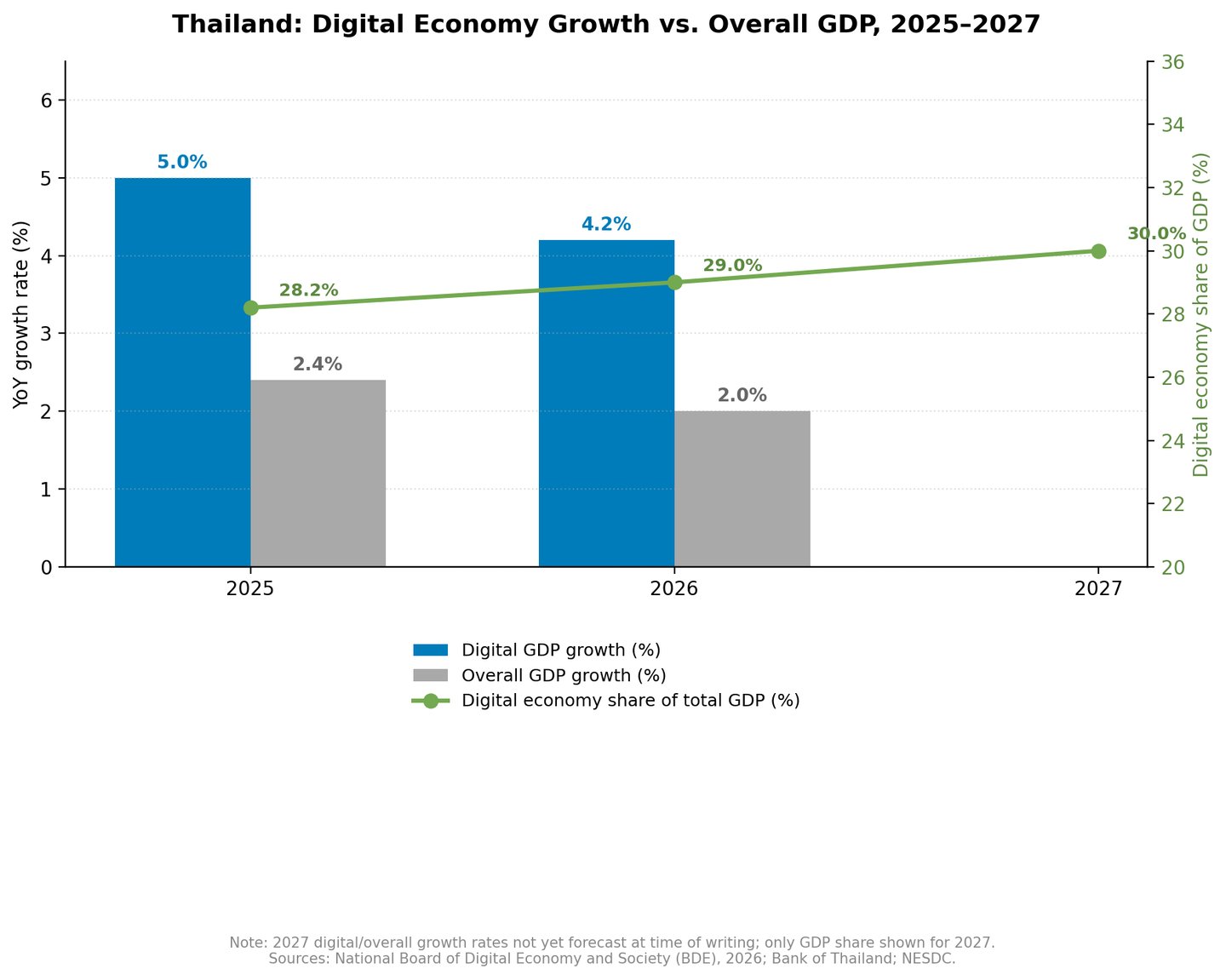
Note: 2027 digital/overall growth rates not yet forecast at time of writing: Only GPD share shown for 2027. Sources: National Board of Digital Economy and Society (BDE), 2026; Bank of Thailand; NESDC.
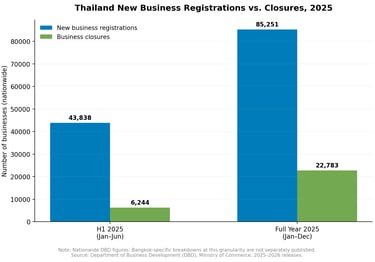
This digital tailwind, however, is set against a harder economic backdrop for new businesses generally. According to the Department of Business Development (DBD), Thailand recorded 85,251 new business registrations nationwide in 2025 — down 2.68% year-on-year — while 22,783 businesses registered to close, down 3.78% from the prior year (DBD, 2026). The DBD's director-general attributed the slowdown in new registrations to a combination of domestic political uncertainty, elevated household debt, a global economic slowdown, and trade tensions along the Thai–Cambodian border. It's worth noting for planning purposes that the DBD does not publish a Bangkok-only breakdown at this level of granularity in its routine releases, nor does it track a cohort-based "survival rate" for businesses registered
registered in a given year — so any claim about what share of a specific year's cohort fails within two years should be treated with caution unless traced to a specific DBD study.
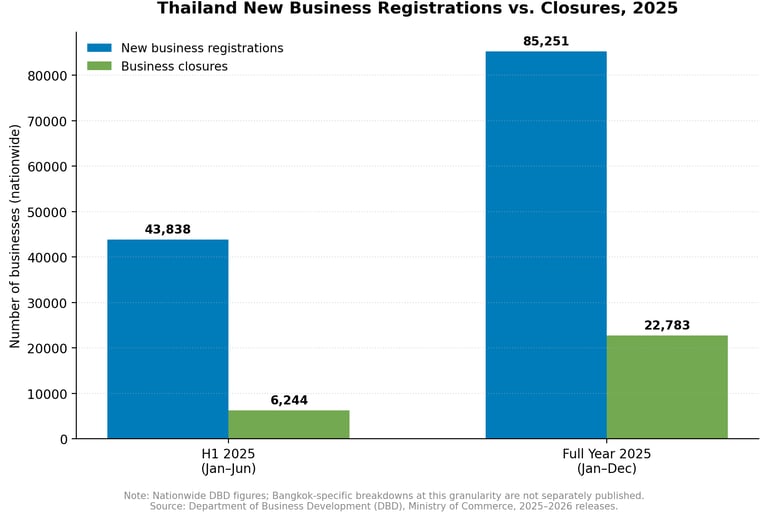
Read together, these figures tell a consistent story: the digital economy is growing meaningfully faster than the economy at large, but overall new-business formation is softening even as closures ease slightly too — a sign of a more cautious, selective startup environment rather than a boom. For founders, this means capital, market fit, and staying power matter more than they did during the faster-growth years of 2023–2024.
The Role of Data-Driven Decision Making
In this environment, market research and quantitative forecasting are no longer luxuries — they are necessities. Startups that rely on intuition or anecdotal evidence risk making costly mistakes, particularly when
the demographic ground is shifting faster than most five-year business plans account for. Instead, founders need robust tools to analyze demographic trends, forecast demand, and assess risk.
Quantitative business forecasting, for instance, allows entrepreneurs to model different scenarios — changes in labor supply, consumer spending patterns by age cohort, or regulatory shifts — and make informed decisions about resource allocation. Risk management strategies, including stress testing and scenario analysis, can help businesses prepare for disruptions such as labor shortages in an aging workforce or shifts in consumer behavior as Thailand's median age continues to climb. Operational streamlining — automating routine tasks, optimizing supply chains, and using digital tools to control costs — becomes even more important in a slower-growth, higher-scrutiny funding environment.
The Path Forward: Planning for the Future
Thailand's demographic shifts are not statistical trivia — they are already-realized forces shaping today's business landscape, with a further, sharper transition (super-aged society status) arriving within the decade. Startups that plan as though the aging transition is still years away risk building for a market that no longer exists by the time they scale. Those that build with both an aging population and a professionalizing, digitally fluent founder and consumer base in mind can position themselves as leaders rather than followers.
The key is to build a foundation of accurate, current data and strategic foresight: conducting thorough market research grounded in verified figures, developing quantitative forecasts, managing risk proactively, and streamlining operations for long-term sustainability — before committing meaningful capital expenditure.
How NEXCELLENCE Can Support Your Business
At NEXCELLENCE, we specialize in helping startups and small enterprises navigate these complexities — and in making sure the numbers behind your business plan are ones you can stand behind. Our services include:
Market Research: In-depth, source-verified analysis of demographic trends, consumer behavior, and competitive landscapes — including custom segmentation (such as Bangkok-specific breakdowns) where published national data isn't granular enough for your decision.
Quantitative Business Forecasting: Advanced modeling techniques to help you predict future demand, revenue, and market conditions against Thailand's shifting demographic base.
Risk Management: Identifying potential risks — from labor-market tightening to funding-cycle shifts — and developing strategies to mitigate them.
Operational Streamlining: Optimizing business processes to improve efficiency, reduce costs, and support scalable growth.
Contact us for your next level of excellence.
References
BDE (2026) Thailand's Digital Economy 2026 — Real Numbers, Real Policies. Available at: https://enersys.co.th/en/insights/thailand-digital-economy-trends-2026 (Accessed: 4 July 2026).
Bangkok Post (2025) Board sees modest drop in digital GDP growth in 2026. Available at: https://www.bangkokpost.com/business/general/3132376/board-sees-modest-drop-in-digital-gdp-growth-in-2026 (Accessed: 4 July 2026).
DBD (2026) Department of Business Development: Data Warehouse and year-end 2025 business registration statistics. Available at: https://datawarehouse.dbd.go.th/ (Accessed: 4 July 2026).
GEM Thailand (2025) Entrepreneurship in Thailand: Record High Start-Up Activity and the Road Ahead. Global Entrepreneurship Monitor. Available at: https://www.gemconsortium.org/news/entrepreneurship-in-thailand:-record-high-start-up-activity-and-the-road-ahead (Accessed: 4 July 2026).
JICA (2025–2026) Survey on Support for Startup and Entrepreneur in Thailand. Available at: https://www.jica.go.jp/english/overseas/thailand/ (Accessed: 4 July 2026).
Krungsri Research (2025) Aged Society: Embracing Challenges and Unlocking Opportunities. Available at: https://www.krungsri.com/en/research/research-intelligence/silver-economy (Accessed: 4 July 2026).
NESDC / UNFPA Thailand (2025) National Transfer Accounts and Thailand's Demographic Trends. Available at: https://thailand.unfpa.org/en/NTA-Global-BKK-2025-English (Accessed: 4 July 2026).
World Bank (2026) Thailand Economic Update. Available at: https://www.worldbank.org/en/country/thailand (Accessed: 4 July 2026